Hat Art Form Most Reflects the Importance Given to Gods Word in Islamic Tradition?

The Basmala in an 18th-century Islamic calligraphy from the Ottoman region, Thuluth script
Islamic calligraphy is the artistic practice of handwriting and calligraphy, in the languages which use Arabic alphabet or the alphabets derived from it. It includes Arabic, Persian, Ottoman, and Urdu calligraphy.[1] [two] Information technology is known in Arabic equally khatt Arabi ( خط عربي ), which translates into Arabic line, design, or construction.[3]
The development of Islamic calligraphy is strongly tied to the Qur'an; chapters and excerpts from the Qur'an are a mutual and nigh universal text upon which Islamic calligraphy is based. Although creative depictions of people and animals are non explicitly forbidden by the Qur'an, pictures have traditionally been limited in Islamic books in guild to avoid idolatry. Although some scholars dispute this, Kufic script was supposedly developed around the end of the 7th century in Kufa, Iraq, from which it takes its name. The style later developed into several varieties, including floral, foliated, plaited or interlaced, bordered, and square kufic. In the ancient world, though, artists would often get effectually this prohibition past using strands of tiny writing to construct lines and images. Calligraphy was a valued art grade, even as a moral good. An ancient Arabic proverb illustrates this point past emphatically stating that "Purity of writing is purity of the soul."[iv]
Nevertheless, Islamic calligraphy is not limited to strictly religious subjects, objects, or spaces. Like all Islamic fine art, it encompasses a various array of works created in a wide variety of contexts.[5] The prevalence of calligraphy in Islamic art is not directly related to its not-figural tradition; rather, it reflects the centrality of the notion of writing and written text in Islam.[half dozen] For instance, the Islamic prophet Muhammad is related to have said: "The first thing God created was the pen."[7]
Islamic calligraphy adult from two major styles: Kufic and Naskh. There are several variations of each, as well as regionally specific styles. Standard arabic or Western farsi calligraphy has also been incorporated into modern art, first with the mail-colonial period in the Middle East, every bit well as the more than recent style of calligraffiti.
Instruments and media [edit]
The traditional instrument of the Islamic calligrapher is the kalam, a pen normally made of dried reed or bamboo. The ink is often in colour and chosen then that its intensity tin can vary profoundly, creating dynamism and movement in the alphabetic character forms. Some styles are oft written using a metallic-tip pen.
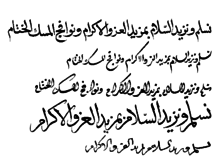
Five principal Standard arabic calligraphic cursive styles:
- Naskh
- Nasta'liq
- Diwani
- Thuluth
- Reqa
Islamic calligraphy can be applied to a broad range of decorative mediums other than paper, such as tiles, vessels, carpets, and rock.[2] Before the appearance of newspaper, papyrus and parchment were used for writing. During the 9th century, an influx of paper from Red china revolutionized calligraphy. While monasteries in Europe treasured a few dozen volumes, libraries in the Muslim earth regularly independent hundreds and fifty-fifty thousands of books.[one] : 218
For centuries, the art of writing has fulfilled a primal iconographic function in Islamic art.[viii] Although the academic tradition of Islamic calligraphy began in Baghdad, the centre of the Islamic empire during much of its early history, it eventually spread every bit far as Bharat and Spain.
Coins were another back up for calligraphy. Beginning in 692, the Islamic caliphate reformed the coinage of the About East by replacing Byzantine Christian imagery with Islamic phrases inscribed in Standard arabic. This was especially true for dinars, or gold coins of high value. By and large, the coins were inscribed with quotes from the Qur'an.
Past the tenth century, the Persians, who had converted to Islam, began weaving inscriptions onto elaborately patterned silks. And then precious were textiles featuring Standard arabic text that Crusaders brought them to Europe as prized possessions. A notable instance is the Suaire de Saint-Josse, used to wrap the bones of St. Josse in the Abbey of St. Josse-sur-Mer, near Caen in north-western France.[one] : 223–5
As Islamic calligraphy is highly venerated, nigh works follow examples set up by well-established calligraphers, with the exception of secular or contemporary works. In the Islamic tradition, calligraphers underwent all-encompassing training in three stages, including the report of their teacher's models, in order to be granted certification.[7]
Styles [edit]

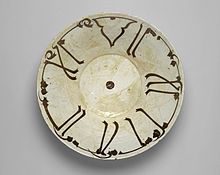
Kufic [edit]
Kufic is the oldest form of the Arabic script. The style emphasizes rigid and angular strokes, which appears as a modified grade of the old Nabataean script.[9] The Archaic Kufi consisted of almost 17 letters without diacritic dots or accents. Diacritical markings were added during the 7th century to help readers with pronunciation of the Qur'an and other important documents, increasing the number of Arabic messages to 28.[x] Although some scholars dispute this, Kufic script was supposedly adult around the end of the 7th century in Kufa, Iraq, from which it takes its proper name.[11] The style afterward developed into several varieties, including floral, foliated, plaited or interlaced, bordered, and square kufic. Due to its direct and orderly style of lettering, Kufic was frequently used in ornamental stone etching likewise as on coins.[12] It was the main script used to re-create the Qur'an from the 8th to 10th century and went out of general use in the 12th century when the flowing naskh style become more applied. Notwithstanding, information technology continued to exist used equally a decorative element to dissimilarity superseding styles.[13]
There was no set up rules of using the Kufic script; the just common feature is the angular, linear shapes of the characters. Due to the lack of standardization of early Kufic, the script differs widely between regions, ranging from very square and rigid forms to flowery and decorative ones.[14]
Mutual varieties include[fourteen] foursquare Kufic, a technique known equally banna'i.[fifteen] Contemporary calligraphy using this way is too popular in modernistic decorations.
Decorative Kufic inscriptions are often imitated into pseudo-kufics in Middle age and Renaissance Europe. Pseudo-kufics is peculiarly common in Renaissance depictions of people from the Holy Land. The exact reason for the incorporation of pseudo-Kufic is unclear. It seems that Westerners mistakenly associated 13th-14th century Middle Eastern scripts with systems of writing used during the time of Jesus, and thus constitute information technology natural to correspond early Christians in association with them.[16]
Naskh and Thuluth [edit]
Naskh [edit]

The use of cursive scripts coexisted with Kufic, and historically cursive was unremarkably used for informal purposes.[17] With the rising of Islam, a new script was needed to fit the pace of conversions, and a well-defined cursive chosen naskh start appeared in the tenth century. Naskh translates to "copying," as it became the standard for transcribing books and manuscripts.[eighteen] The script is the most ubiquitous among other styles, used in the Qur'an, official decrees, and private correspondence.[xix] Information technology became the basis of modern Arabic impress.
Standardization of the style was pioneered by Ibn Muqla (886 – 940 A.D.) and later expanded by Abu Hayan at-Tawhidi (died 1009 A.D.). Ibn Muqla is highly regarded in Muslim sources on calligraphy as the inventor of the naskh style, although this seems to exist erroneous. Since Ibn Muqla wrote with a distinctly rounded manus, many scholars drew the conclusion that he founded this script. Ibn al-Bawwab, the student of Ibn Muqla, is actually believed to have created this script.[18] However, Ibn Muqla did establish systematic rules and proportions for shaping the messages, which apply 'alif as the x-acme, and the dot as basic measurement.[20]
Thuluth [edit]
Thuluth was developed during the 10th century and slowly refined by Ottoman Calligraphers including Mustafa Râkim, Shaykh Hamdallah, and others, till it became what information technology is today. Letters in this script have long vertical lines with broad spacing. The name, significant "one third", may possibly be a reference to the x-superlative, which is one-third of the 'alif, or to the fact that the pen used to write the vowels and ornaments is one third the width of that used in writing the letters.[21]
Variations:
- Reqa' is a handwriting way like to thuluth. It kickoff appeared in the tenth century. The shape is unproblematic with short strokes and small flourishes. Yaqut al-Musta'simi was one of the calligraphers who employed this way.[22] [23]
- Muhaqqaq is a majestic style used by accomplished calligraphers, and is a variation of thuluth. Forth with thuluth, it was considered one of the well-nigh cute scripts, also as one of the nigh difficult to execute. Muhaqqaq was normally used during the Mamluk era, but its utilise became largely restricted to short phrases, such as the basmallah, from the 18th century onward.[24]
Regional styles [edit]
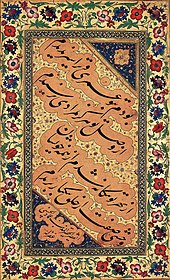
Nasta'liq calligraphy of a Western farsi poem past Mir Emad Hassani, possibly the most celebrated Persian calligrapher
With the spread of Islam, the Arabic script was established in a vast geographic area with many regions developing their own unique style. From the 14th century onward, other cursive styles began to develop in Turkey, Persia, and Cathay.[19]
- Maghrebi scripts developed from Kufic letters in the Maghreb (North Africa) and al-Andalus (Iberia), Maghrebi scripts are traditionally written with a pointed tip (القلم المذبب), producing a line of even thickness. Inside the Maghrebi family, in that location are dissimilar styles including the cursive mujawher and the ceremonial mabsut.
- Sudani scripts adult in Biled every bit-Sudan (the Due west African Sahel) and can be considered a subcategory of Maghrebi scripts
- Diwani is a cursive fashion of Arabic calligraphy developed during the reign of the early Ottoman Turks in the 16th and early 17th centuries. It was invented past Housam Roumi, and reached its peak of popularity under Süleyman I the Magnificent (1520–1566).[25] Spaces between letters are frequently narrow, and lines ascend upwards from right to left. Larger variations called djali are filled with dense decorations of dots and diacritical marks in the space between, giving it a meaty advent. Diwani is difficult to read and write due to its heavy stylization and became the ideal script for writing court documents equally information technology ensured confidentiality and prevented forgery.[14]
- Nasta'liq is a cursive fashion originally devised to write the Persian language for literary and non-Qur'anic works.[14] Nasta'liq is thought to be a afterwards development of the naskh and the earlier ta'liq script used in Islamic republic of iran.[26] Quite quickly gaining popularity as a script in Southern asia. The name ta'liq means "hanging," and refers to the slightly sloped quality of lines of text in this script. Letters have short vertical strokes with broad and sweeping horizontal strokes. The shapes are deep, hook-similar, and accept high contrast.[fourteen] A variant called Shikasteh was developed in the 17th century for more formal contexts.
- Sini is a style developed in Red china. The shape is greatly influenced by Chinese calligraphy, using a horsehair brush instead of the standard reed pen. A famous modern calligrapher in this tradition is Hajji Noor Deen Mi Guangjiang. [27]
Modern [edit]
In the post-colonial era, artists working in North Africa and the Middle East transformed Arabic calligraphy into a modern art movement, known equally the Hurufiyya motion.[28] Artists working in this fashion use calligraphy as a graphic element within contemporary artwork.[29] [30]
The term, hurufiyya is derived from the Arabic term, harf for letter. Traditionally, the term was charged with Sufi intellectual and esoteric significant.[28] It is an explicit reference to a medieval system of teaching involving political theology and lettrism. In this theology, letters were seen as primordial signifiers and manipulators of the cosmos. [31]
Hurufiyya artists blended Western art concepts with an artistic identity and sensibility drawn from their ain culture and heritage. These artists integrated Islamic visual traditions, especially calligraphy, and elements of modern art into syncretic contemporary compositions.[32] Although hurufiyyah artists struggled to find their own private dialogue inside the context of nationalism, they also worked towards an aesthetic that transcended national boundaries and represented a broader affiliation with an Islamic identity.[28]
The hurufiyya artistic style every bit a movement most probable began in N Africa effectually 1955 with the work of Ibrahim el-Salahi.[28] However, the utilise of calligraphy in mod artworks appears to have emerged independently in various Islamic states. Artists working in this were often unaware of other hurufiyya artists'due south works, allowing for different manifestations of the style to emerge in different regions.[33] In Sudan, for instance, artworks include both Islamic calligraphy and West African motifs.[34]
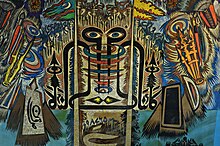
The Roof of Frere Hall, Karachi, Islamic republic of pakistan, c. 1986. Mural past artist, Sadequain Naqqash integrates calligraphy elements into a modern artwork.
The hurufiyya art movement was not confined to painters and included artists working in a variety of media.[35] One example is the Jordanian ceramicist, Mahmoud Taha who combined the traditional aesthetics of calligraphy with skilled craftsmanship.[36] Although not affiliated with the hurufiyya movement, the contemporary creative person Shirin Neshat integrates Arabic text into her black-and-white photography, creating contrast and duality. In Republic of iraq, the motility was known as Al Bu'd al Wahad (or the One Dimension Grouping)",[37] and in Islamic republic of iran, it was known as the Saqqa-Khaneh motility.[28]
Western fine art has influenced Standard arabic calligraphy in other ways, with forms such as calligraffiti, which is the utilise of calligraphy in public fine art to brand political leader-social messages or to decoration public buildings and spaces.[38] Notable Islamic calligraffiti artists include: Yazan Halwani agile in Lebanon [39] , el Seed working in France and Tunisia, and Caiand A1one in Tehran.[40]
In 2017 the Sultanate of Oman unveiled the Mushaf Muscat, an interactive calligraphic Quran following supervision and support from the Omani Ministry of Endowments and Religious Affairs, a voting member of the Unicode Consortium.[41]
Gallery [edit]
Kufic [edit]
-
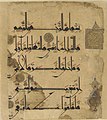
Kufic script in an 11th-century Qur'an
-

Square kufic tilework in Yazd, Islamic republic of iran
-

Under-coat terracotta basin from the 11th century Nishapur
Naskh and Thuluth [edit]
-
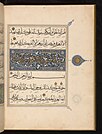
Muhaqqaq script in a 15th-century Qur'an from Turkey
-

Muhaqqaq script in a 13th-century Qur'an
-
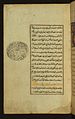
Naskh script in an early 16th-century Ottoman manuscript dedicated to Selim I
-
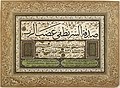
Diploma of competency in calligraphy, written with thuluth and naskh script
Regional varieties [edit]

Modernistic examples [edit]


Arts and crafts [edit]
-
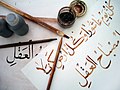
The instruments and work of a pupil calligrapher
-
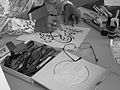
Islamic calligraphy performed by a Malay Muslim in Malaysia. Calligrapher is making a rough typhoon.
Listing of calligraphers [edit]
Some classical calligraphers:
- Medieval
- Ibn Muqla (d. 939/940)
- Ibn al-Bawwab (d. 1022)
- Fakhr-united nations-Nisa (12th century)
- Yaqut al-Musta'simi (d. 1298)
- Mir Ali Tabrizi (d. 14th–15th century)
- Ottoman era
- Shaykh Hamdullah (1436–1520)
- Hamid Aytaç (1891-1982)
- Seyyid Kasim Gubari (d. 1624)
- Hâfiz Osman (1642–1698)
- Mustafa Râkim (1757–1826)
- Mehmed Shevki Efendi (1829–1887)
- Contemporary
- Abdul Djalil Pirous, known every bit A.D. Pirous (b. 1933), Indonesian painter and lecturer
- Ali Adjalli (b. 1939), Iranian master calligrapher, painter, poet and educator
- Wijdan Ali (b. 1939), Jordan
- Hashem Muhammad al-Baghdadi (1917-1973), Iraq
- Mohammad Hosni (1894-1964), Syria
- Shakkir Hassan Al Sa'id (1925-2004), Republic of iraq
- Madiha Omar (1908-2005), Iraqi-American
- Sadequain Naqqash (1930-1987), Pakistan
- Ibrahim el-Salahi (b. 1930), Sudan
- Mahmoud Taha (b. 1942), Jordan
- Charles Hossein Zenderoudi (b. 1937), Iran
- Abdulraouf Baydoun (b. 1956), Syrian arab republic
- Mohamed Zakariya (b. 1942), U.s. of America
- Hassan Massoudy (b. 1944), Iraq, France
- Amir Kamal (b. 1972), Islamic republic of pakistan
- Uthman Taha (b. 1934), Syrian arab republic
- Abas Baghdadi, Iraq
- Mothanna Al-Obaydi, Iraq
Come across also [edit]
- Illuminated manuscript
- Islamic compages
- Islamic Gilded Age
- Islamic graffiti
- Islamic miniature
- Islamic pottery
- Museum of Turkish Calligraphy Art
- Ottoman Turkish linguistic communication
- Persian calligraphy
- Sini (script)
- Uthman Taha
References [edit]
- ^ a b c Blair, Sheila S.; Bloom, Jonathan G. (1995). The art and compages of Islam : 1250–1800 (Reprinted with corrections ed.). New Oasis: Yale University Press. ISBN0-300-06465-9.
- ^ a b Chapman, Caroline (2012). Encyclopedia of Islamic Art and Architecture, ISBN 978-979-099-631-1
- ^ Julia Kaestle (x July 2010). "Arabic calligraphy equally a typographic exercise".
- ^ Lyons, Martyn. (2011). Books : a living history. Los Angeles: J. Paul Getty Museum. ISBN978-1-60606-083-iv. OCLC 707023033.
- ^ Blair, Sheila S. (Spring 2003). "The Delusion of Islamic Fine art: Reflections on the Report of an Unwieldy Field". The Fine art Bulletin. 85: 152–184 – via JSTOR.
- ^ Allen, Terry (1988). Five Essays on Islamic Art. Sebastopol, CA: Solipsist Printing. pp. 17–37. ISBN 0944940005.
- ^ a b Roxburgh, David J. (2008). ""The Center is Favored for Seeing the Writing's Form": On the Sensual and the Sensuous in Islamic Calligraphy". Muqarnas. 25: 275–298 – via JSTOR.
- ^ Tabbaa, Yasser (1991). "The Transformation of Standard arabic Writing: Part I, Qur'ānic Calligraphy". Ars Orientalis. 21: 119–148.
- ^ Flood, Necipoğlu (2017). A Companion to Islamic Fine art and Architecture. Vol. I. Hoboken: John Wiley & Sons. pp. 109–110. ISBN9781119068570. OCLC 963439648.
- ^ Schimmel, Annemarie (1984). Calligraphy and Islamic Culture. New York: New York University Press. p. 4. ISBN 0814778305.
- ^ Kvernen, Elizabeth (2009). "An Introduction of Arabic, Ottoman, and Persian Calligraphy: Mode". Calligraphy Qalam., Schimmel, Annemarie (1984). Calligraphy and Islamic Culture. New York: New York University Press. p. 3. ISBN 0814778305.
- ^ Ul Wahab, Zain; Yasmin Khan, Romana (30 June 2016). "The Chemical element of Mural Art and Mediums in Potohar Region". Journal of the Research Society of Pakistan. Vol. 53; No. 1 – via Nexis Uni.
- ^ "Kūfic script". Encyclopædia Britannica.
- ^ a b c d e Kvernen, Elizabeth (2009). "An Introduction of Arabic, Ottoman, and Persian Calligraphy: Manner". Calligraphy Qalam.
- ^ Jonathan M. Bloom; Sheila Blair (2009). The Grove encyclopedia of Islamic fine art and architecture. Oxford University Printing. pp. 101, 131, 246. ISBN978-0-nineteen-530991-i . Retrieved 4 January 2012.
- ^ Mack, Rosamond E. Bazaar to Piazza: Islamic Trade and Italian Fine art, 1300–1600, Academy of California Press, 2001 ISBN 0-520-22131-1
- ^ Mamoun Sakkal (1993). "The Fine art of Standard arabic Calligraphy, a cursory history".
- ^ a b Blair, Sheila Due south. (2006). Islamic Calligraphy. Edinburgh Academy Press. pp. 158, 165. ISBN 0748612122.
- ^ a b "Library of Congress, Selections of Standard arabic, Persian, and Ottoman Calligraphy: Qur'anic Fragments". International.loc.gov. Retrieved 4 December 2013.
- ^ Kampman, Frerik (2011). Standard arabic Typography; its past and its future
- ^ Kvernen, Elisabeth (2009). "Thuluth and Naskh". CalligraphyQalam . Retrieved 26 Nov 2018.
- ^ "خط الرقاع". instance.ampproject.org . Retrieved 16 Apr 2021.
{{cite web}}: CS1 maint: url-status (link) - ^ Kvernen, Elizabeth (2009). "Tawqi' and Riqa'". CalligraphyQalam . Retrieved 26 November 2018.
- ^ Mansour, Nassar (2011). Sacred Script: Muhaqqaq in Islamic Calligraphy. New York: I.B.Tauris & Co Ltd. ISBN 978-1-84885-439-0
- ^ "Diwani script". Encyclopædia Britannica.
- ^ "Ta'liq Script". Encyclopædia Britannica.
- ^ "Gallery" Archived 31 October 2015 at the Wayback Automobile, Haji Noor Deen.
- ^ a b c d e Inundation, Necipoğlu (2017). A Companion to Islamic Art and Architecture. Volume 2. Hoboken: John Wiley & Sons. pp. 1294. ISBN 1119068665. OCLC 1006377297.
- ^ Mavrakis, N., "The Hurufiyah Art Movement in Middle Eastern Art", McGill Journal of Middle Eastern Studies Weblog
- ^ A. and Masters, C., A-Z Smashing Modern Artists, Hachette UK, 2015, p. 56
- ^ Mir-Kasimov, O., Words of Power: Hurufi Teachings Between Shi'ism and Sufism in Medieval Islam, I.B. Tauris and the Found of Ismaili Studies, 2015
- ^ Lindgren, A. and Ross, S., The Modernist World, Routledge, 2015, p. 495; Mavrakis, N., "The Hurufiyah Art Movement in Middle Eastern Art," McGill Periodical of Middle Eastern Studies Blog, Online: https://mjmes.wordpress.com/2013/03/08/commodity-5/; Tuohy, A. and Masters, C., A-Z Nifty Modern Artists, Hachette U.k., 2015, p. 56
- ^ Dadi. I., "Ibrahim El Salahi and Calligraphic Modernism in a Comparative Perspective," S Atlantic Quarterly, 109 (3), 2010, pp. 555–576, DOI:https://doi.org/10.1215/00382876-2010-006; Overflowing, F.B. and Necipoglu, Chiliad. (eds) A Companion to Islamic Art and Compages, Wiley, 2017, p. 1294
- ^ Flood, Necipoğlu (2017). A Companion to Islamic Fine art and Architecture. Volume II. Hoboken: John Wiley & Sons. pp. 1298-1299. ISBN 1119068665. OCLC 1006377297.
- ^ Mavrakis, North., "The Hurufiyah Art Movement in Middle Eastern Art," McGill Journal of Middle Eastern Studies Weblog, Online: https://mjmes.wordpress.com/2013/03/08/article-5/;Tuohy "Unknown". Retrieved 25 March 2020. [ dead link ] , A. and Masters, C., A-Z Great Mod Artists, Hachette Great britain, 2015, p. 56; Dadi. I., "Ibrahim El Salahi and Calligraphic Modernism in a Comparative Perspective," S Atlantic Quarterly, 109 (3), 2010, pp. 555–576, DOI:https://doi.org/ten.1215/00382876-2010-006
- ^ Asfour. G., "A Window on Contemporary Arab Art," NABAD Fine art Gallery, Online: http://world wide web.nabadartgallery.com/
- ^ "Shaker Hassan Al Said," Darat al Funum, Online: world wide web.daratalfunun.org/master/activit/curentl/anniv/exhib3.html; Flood, Necipoğlu (2017). A Companion to Islamic Fine art and Architecture. Book Two. Hoboken: John Wiley & Sons. pp. 1294. ISBN 1119068665. OCLC 1006377297.
- ^ Grebenstein, Thou., Calligraphy Bible: A Complete Guide to More than 100 Essential Projects and Techniques, 2012, p. 5
- ^ Alabaster, Olivia. "I like to write Beirut as it'due south the urban center that gave us everything", The Daily Star, Beirut, 9 February 2013
- ^ Vandalog (3 May 2011). "A1one in Tehran Islamic republic of iran". Vandalog . Retrieved 8 October 2012.
- ^ Martin Lejeune, xv June 2017, Oman unveils world's 1st interactive calligraphic Quran
External links [edit]
- Islamic Calligraphy Pictures
- Mushaf Muscat
- mastersofistanbul.com
- baradariarts.com
- Gallery with much calligraphy in Turkish mosque
- Anthology of Persian calligraphers from tenth to 20th centuries
Source: https://en.wikipedia.org/wiki/Islamic_calligraphy
0 Response to "Hat Art Form Most Reflects the Importance Given to Gods Word in Islamic Tradition?"
ارسال یک نظر